

Patriarchal Predecessors & Abbots
BIOGRAPHY OF ELDER MOST VENERABLE THICH PHAP CAO
A VIRTUOUS SENIOR MONK, DEVOTING HIS ENTIRE LIFE WITH PATIENCE, SERVICE, AND SELFLESSNESS
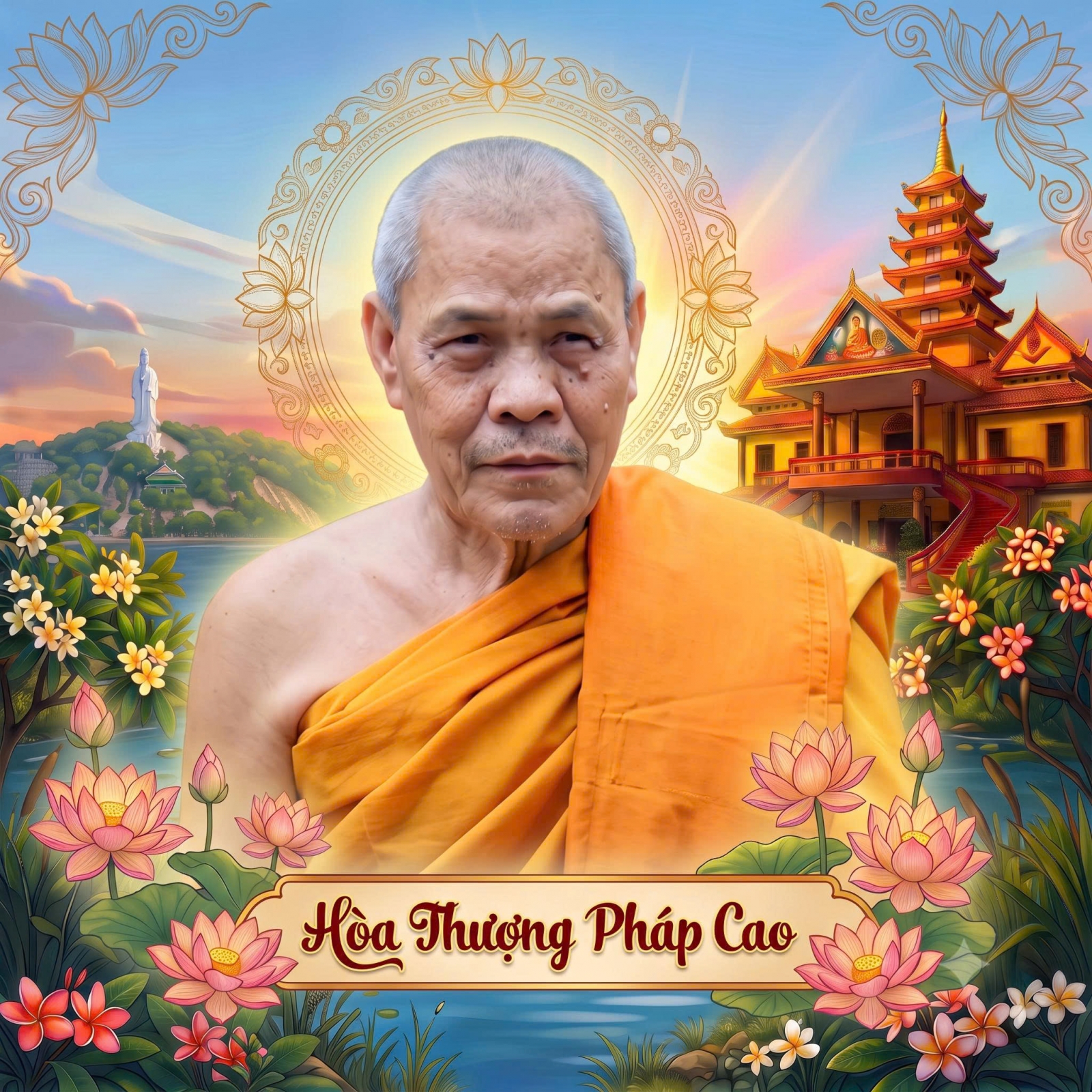
(Member of the Advisory Council of the Vietnam Buddhist Sangha, Former Member of the Executive Council of the Vietnam Buddhist Sangha, Advisory Patriarch of the Executive Board of the Vietnam Buddhist Sangha in Da Nang City, Abbot Emeritus and Former Abbot of Tam Bao Patriarchal Monastery)
I. Auspicious Childhood Roots and the Shade of the Monastery
There are true practitioners who pass through life like a still river, stirring no noisy waves, yet silently depositing alluvial soils for generations to come. Elder Most Venerable Thich Phap Cao is precisely such a symbol of simplicity, humility, and steadfastness amidst the stream of Theravada Buddhism in Vietnam.
Elder Most Venerable Thich Phap Cao, whose lay name was Nguyen Quit, was born on March 8, 1951 (civil registry records March 1, 1951) in Phuoc Ninh village, now located in Hai Chau district, Da Nang city. He was born into a warm family on the Central strip of land weathered by sea winds and salt. His father was Mr. Nguyen Thuong, and his mother was Mrs. Truong Thi Se (later turning to the Dharma and ordaining as a female monastic under the dharmic name Thien An; both parents have since passed away). Bathed in the roots of parental care and a virtuous family lifestyle, the seed of Bodhi sprouted early within him. In 1964, at the tender age of 13, he deeply perceived the truth of impermanence, laying aside all worldly ties to step into the monastic gate, ordaining and studying at Tam Bao Monastery (Da Nang). The morning and evening temple bells alongside pure yellow robes embraced his youthful soul, forging the vow of renunciation from his very first steps in life.
II. Devotion to the Master, the Light of Bodhi, and the Path of Ordination
In 1969, at the age of 18, a burning aspiration to penetrate the core of pristine Theravada Buddhism brought the young monastic to the South, joining the community to study at Phat Bao Temple (Tam Binh, Gia Dinh – now Thu Duc City, HCMC). In this solemn monastery, he had the good fortune to rely upon and take refuge under the Supreme Monastic Jewel: the late Great Elder Most Venerable Thich Gioi Nghiem – the supreme accomplished senior monk, former Supreme Patriarch of the Vietnamese Theravada Sangha, and Deputy Supreme Patriarch of the Advisory Council of the Vietnam Buddhist Sangha.
The years of studying as a novice at Phat Bao Temple served as an invaluable experiential lesson in humility and devotion. Unfazed by labor and manual service, he quietly carried buckets of water, chopped bundles of firewood, and boiled pots of water early and late to serve the monastic community at the Phat Bao Buddhist Institute. At the same time, he poured his love and care into serving as a young teacher at the Tam Bao Bodhi Private School of Phat Bao Temple (the temple's charity literacy class). Amidst difficult times, every letter and every moral lesson he thoughtfully imparted illuminated the future for countless poor children in the surrounding region.
Recognizing his pure monastic discipline and solemn deportment, in that same year of 1969, the Master permitted him to take higher ordination (Bhikkhu) at the ordination platform of Phat Bao Temple. From then on, a pure Bhikkhu officially entered the supreme monastic assembly, continuing the lifeline of Theravada Buddhism.
III. Bearing Heavy Monastic Burdens and Complete Filial Piety Toward His Mother
Following the nation's peace and reunification, in 1973, the Venerable returned to his ancestral Central homeland. Facing a historical period full of turbulence and challenges, his endurance, humility, and oceanic calmness became a solid pillar of support for senior monastic elders.
The highest senior monks of the lineage—from Supreme Patriarch Thich Gioi Nghiem to Deputy Patriarch Thich Phap Lac—bestowed absolute trust upon him, entrusting the preservation of the spiritual lifeline in the Central region. For over four decades (from 1976 to 2019), the Venerable single-handedly shouldered the position of Abbot and cared for developing practice centers across all three major foundational monasteries of Southern Buddhism in Quang Nam – Da Nang: Tam Bao Monastery, Nam Quang Temple (Hoi An), and Thai Binh Temple (Dien Ban). Under his silent shelter, ancient temples that weathered historical storms were restored to prosperity, solemnly welcoming devotees from all directions.
Amidst countless demanding monastic duties, people could still witness the brilliant filial piety of a Buddhist son. When he assumed abbacy at Nam Quang Temple, he thoughtfully welcomed his biological mother, Mrs. Truong Thi Se, into the temple, assisting her in shaving her head and ordaining as a female monastic under the dharmic name Thien An. Though traveling back and forth to attend to monastic affairs, the Venerable personally cared for her, brewing her medicine and offering her meals with tender care, diligently tending to his elderly mother in the monastery until she peacefully passed away. The virtue of filial piety of a renunciant shone brightly: above, he served his Master; below, he fully repaid the grace of parental birth.
Beyond temple management, he dedicated himself wholeheartedly to the Sangha: serving for nearly four decades as Deputy Head of the Executive Board of the Vietnam Buddhist Sangha in Da Nang City (1985 – 2021), a Member of the Executive Council of the Vietnam Buddhist Sangha (2012 – 2022), and being elevated to the noble position of Member of the Central Advisory Council of the Vietnam Buddhist Sangha starting in 2022.
IV. Resilience Through Storms and the Lesson of Selfless Letting Go
The Venerable's path in both the worldly and spiritual realms was not paved with roses. There were stormy moments, challenges, and swirling worldly shifts. Yet no one ever saw him argue, complain, or blame anyone. The virtue of "patience and few words" became his natural character. He used the silence of a sage to dissolve all adversities, meditation to transform sorrows, and monastic discipline as an unbreakable fortress. Such silent endurance helped him steadfastly steer the boat of the Dharma through every violent tempest.
However, what made contemporary venerable elders respect him most was his spirit of selfless release in his later years: Starting at age 65, when his health remained robust, his intellect sharp, and his monastic standing at its peak, the Venerable began prudently arranging legal and administrative procedures for the Sangha; until in 2019, at age 68, he executed the succession handover, completing procedures to appoint and transfer abbot positions of all three major monasteries to succeeding generations of authentic disciples: appointing Venerable Thich Phap Hieu as Abbot of Tam Bao Monastery, Venerable Thich Phap Trung as Abbot of Nam Quang Temple, and Venerable Thich Phap Hanh as Abbot of Thai Binh Temple.
Having fulfilled the succession handover, he smiled serenely, gracefully stepping back into the position of Abbot Emeritus and Advisory Elder, closing worldly responsibilities to enter solitary retreat and dwell in independent meditation like a hidden practitioner. His calm and effortless relinquishment of heavy responsibilities while at the peak of monastic prestige remains an invaluable experiential lesson on letting go that a thousand Dharma talks cannot match.
V. Nurturing Monastic Talents, Opening the Path for Nuns, and Lighting the Flame of Vipassanā
The greatest legacy Elder Most Venerable Thich Phap Cao left for posterity is not material construction, but rather "people" and "the path of liberation":
A Nursery of Renowned Monastic Talents: Through nurturing care from early childhood, he raised and gave wings to generations of disciples to become pillars of the Sangha:
- The late Most Venerable Dr. Thich Hue Duc: An outstanding scholarly monk who earned his Ph.D. in Buddhist Studies in India, who collaborated with the Venerable to restore Nam Quang Temple and propagate meditation before peacefully passing away.
- Venerable Thich Phap Hieu: M.A. in Pali Buddhist Studies (Sri Lanka), Abbot of Tam Bao Monastery, Member of the Central International Buddhist Committee of the Vietnam Buddhist Sangha, Executive Member of the Central Committee of the Vietnam – Laos Friendship Association, actively participating in international friendship bridges.
- Venerable Thich Phap Trung: Successor Abbot of Nam Quang Temple (Hoi An).
- Venerable Thich Phap Hanh: Successor Abbot of Thai Binh Temple (Dien Ban).
He personally brought his young disciple Phap Hieu to Hue to pay respects to Most Venerable Ho Nhan for novice ordination, and created favorable conditions to send his disciples to study in Myanmar and Sri Lanka, cultivating blossoms of wisdom for the world.
Founding Sala Meditation Hermitage – Supporting the Order of Nuns: Deeply understanding the aspiration for spiritual practice among female Southern monastics, he poured his compassion into founding Sala Meditation Hermitage and officially establishing the Order of Nuns, creating a solemn meditative realm for female monastics to peacefully refine body and mind and cultivate moral virtue.
Lighting the Flame of Vipassanā Meditation and the "Temporary Ordination" Movement (Xuất gia gieo duyên): At Nam Quang Temple, he labored to transform the site into a model Vipassanā meditation center in the Central region, regularly organizing intensive meditation retreats ranging from 10 days to 1 month for thousands of practitioners. Notably, since the early 2000s, he was a pioneer senior preceptor launching the "Temporary Ordination" movement, hosting retreats gathering nearly 300 candidates wearing pure yellow robes, planting priceless Bodhi seeds in countless minds.
Conclusion Throughout a lifetime spanning over half a century wearing patched robes, Elder Most Venerable Thich Phap Cao never chased illusory fame or profit. From the 13-year-old novice sweeping the leaves of Tam Bao courtyard, the yellow-robed teacher teaching literacy at Phat Bao Bodhi School, the filial son caring for his aging mother in the monastery, to the supreme Advisory Elder of the Sangha, he always maintained his simple, compassionate, and quiet lifestyle.
He came, he lived, he patiently traversed countless storms, and then effortlessly let go of everything like a golden leaf gently falling back to its roots. His solitary meditative silhouette today stands as a quiet lighthouse, illuminating the path of liberation and reminding posterity of the virtues of "Patience" (Nhẫn nại), "Filial Piety" (Hiếu), and "Letting Go" (Buông) completely amidst the human realm.
Recorded by Venerable Thich Phap Hieu