

Patriarchal Predecessors & Abbots
BIOGRAPHY OF THE LATE GREAT ELDER MOST VENERABLE THICH GIOI NGHIEM (THITASĪLA MAHĀTHERA) (1921 – 1984)
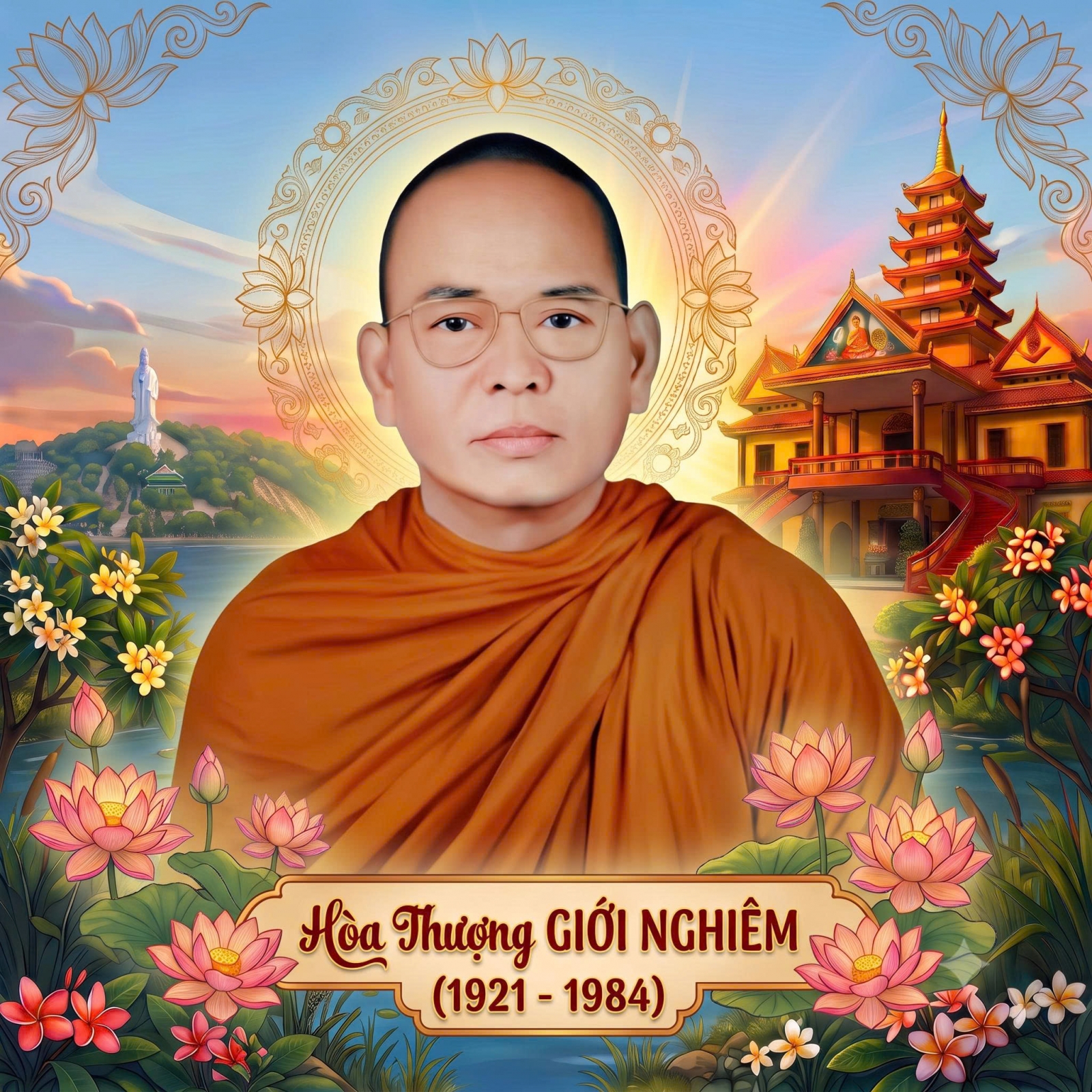
(Former Supreme Patriarch of the Vietnamese Theravada Sangha, Member of the Advisory Council, Vice Chairman of the Executive Council of the Vietnam Buddhist Sangha, and First Founder of Tam Bao Patriarchal Monastery in Da Nang)
I. Auspicious Childhood Roots, Aspiration for Renunciation, and the Path of Seeking the Dharma Abroad
There are great beings who manifest in the human realm like the shade of a grand tree sheltering the world, passing through life with a calm demeanor yet leaving behind an indestructible mark for eternity. The late Great Elder Most Venerable Thich Gioi Nghiem (dharmic name Thitasīla) was precisely such a representative pillar of the monastic community in Vietnamese Buddhism.
His lay name was Nguyen Dinh Tran, born on May 5, 1921, in Gia Le Thuong village, Huong Thuy district, Thua Thien – Hue province. He originated from a kind-hearted family with a long-standing traditional ethical background in a poor rural area. Although weathered by storms, it was a land that gave birth to many virtuous and disciplined senior monks of both the Southern and Northern traditions. Within his lineage, his paternal uncle, Most Venerable Thich Phuoc Duyen, and another paternal uncle were both monastics who attained liberation. His father, Mr. Nguyen Dinh Tai, after living a devoted life half-way with his mother, Mrs. Huynh Thi Thanh, also severed worldly ties and ordained, living out his life in purity under the dharmic name Most Venerable Thich Quang Diệu.
Bathed in the pure blessing roots of his lineage, the seed of Bodhi sprouted early within him. At the age of 9 (1930), he deeply perceived the truth of impermanence, seeking out a primitive, remote ancient temple in Bang Lang village to renounce the world, study, and receive novice ordination. By 1940, amidst war and turmoil in his homeland obstructing his studies, he traveled south to Da Nang, seeking refuge under the monastic roof of Pho Da Temple, and subsequently took higher ordination (Bhikkhu) according to the Northern Mahayana tradition.
At that time, the stream of pure Theravada Buddhist teachings began to spread into Vietnamese soil. Due to his multi-lifetime cumulative merits and sharp, sensitive wisdom, he realized that the pristine Southern Tipitaka and teachings were the unadulterated source of authentic transmission, entirely free of foreign ideological mixtures. With auspicious conditions ripened, in 1944, supported by virtuous friends, he set out to study in Phnom Penh (Cambodia). In 1947, the Sangharaja of Cambodia conferred upon him the higher Bhikkhu ordination according to the Theravada tradition. Notably, he had the profound destiny of studying profound doctrines directly with the Supreme Patriarch of Cambodia – Elder Most Venerable Chuon-Nath.
Driven by a deep aspiration to enter the realm of experiential practice, he continued from Cambodia to Thailand and Myanmar to seek masters and learn the Dharma. In Myanmar, he had the good fortune to study the Four Foundations of Mindfulness meditation directly under the world-renowned meditation master – Mahāsī Sayādaw. After more than a decade of traveling abroad in search of truth, enduring countless hardships and trials in a foreign land, he returned home carrying the ancient yet fresh teachings of the World-Honored One to illuminate his homeland.
II. Founding Tam Bao Patriarchal Monastery (1953 – 1983): A Training Institute for Monastic Talents, a Vipassanā Meditation Center, and Tue Tĩnh Đường Herbal Clinic for Human Relief
In 1953, after more than a decade of diligent study and practice overseas, Most Venerable Gioi Nghiem returned home with the aspiration to pioneer the propagation of pristine Theravada Buddhism. His first historical stop on the Central strip of land was the coastal city of Da Nang, where he laid the foundation stone to construct the Tam Bao monastery at No. 323 Phan Chau Trinh Street. From this milestone in 1953 until 1983 (before handing over succession to his disciple, Most Venerable Thich Phap Cao), spanning a full 30 years, Tam Bao Temple officially became the first ancestral monastery, the root birthplace of Southern Buddhism in the Central region, and closely tied to the most glorious missionary period of the Founding Patriarch:
- Training Institute for Monastic Talents and Public Education: At Tam Bao Monastery, he founded the Tam Bao Primary Buddhist Institute combined with opening the Tam Bao Bodhi Private School. The school served both as a sanctuary opening knowledge for children of poor families in the surrounding region and as a disciplined monastic cradle nurturing generations of foundational monastic talents for the sect. Many virtuous senior monks of Vietnamese Theravada Buddhism later received their ordination, had their hair shaved, took monastic vows, and wore pure yellow robes under his guidance beneath the roof of Tam Bao Monastery in Da Nang. From this source, the monastic community spread in all directions, becoming pillars of the Dharma propagating both domestically and abroad.
- The Vipassanā Meditation Center of the Central Region – The Abdomen Rising and Falling Mindfulness Method: As a pioneering senior monk receiving the authentic Four Foundations of Mindfulness meditation tradition from Meditation Master Mahāsī Sayādaw, Most Venerable Gioi Nghiem transformed Tam Bao Monastery into the first standard Vipassanā meditation center in the Central region. At the solemn Stupa Temple, he continuously opened intensive meditation retreats, personally guiding the method of contemplating the rising and falling movements of the abdomen with each natural breath. This simple style of meditation, directly perceiving body and mind in each present moment, guided thousands of monk, nun, and lay Buddhist practitioners to cleanse afflictions and find liberating peace right amidst a fluctuating world.
- Tue Tĩnh Đường Herbal Clinic for Human Relief – The Complete Vow of Compassion: Understanding the sufferings of humanity caused by illness, he established the Tam Bao Temple Tue Tĩnh Đường Herbal Clinic right on the temple grounds. Applying traditional national medicine and precious herbal sources, Tue Tĩnh Đường became a familiar refuge for poor laborers. Here, ailing and impoverished patients received free pulse diagnosis, acupuncture, and herbal medicine treatments entirely free of charge, leaving a deep impression of compassionate relief in the minds of Quang Nam – Da Nang people over many years.
- Preserving Sacred Relics and Traditional Diplomatic Mementos: During his abbacy at Tam Bao Monastery, he welcomed deep support and bonds with traditional Buddhist nations: respectfully receiving the Buddha's Sarira, receiving two grand Bodhi trees from Elder Narada (India & Sri Lanka), along with sets of Pali Tipitaka scriptures, palm-leaf scriptures, and vermilion gold-gilt Triple Gem altars offered by the Thai Royal Family.
III. Missionary Footprints Across Three Regions and Service to the Sangha
When the seeds of the Dharma at Tam Bao Monastery in the Central region blossomed and bore fruit, answering the requests of venerable elders and the developmental needs of the lineage, Most Venerable Gioi Nghiem expanded his missionary steps to the South and all regions of the country:
- Establishing the Vietnamese Theravada Sangha: In 1957 in Saigon, he and senior venerable monks of great virtue—such as Most Venerable Ho Tong, Most Venerable Buu Chon, Most Venerable Thien Luat, Most Venerable Giac Quang...—unanimously campaigned to establish the Vietnamese Theravada Sangha. With strict monastic conduct and complete virtue and talent, he was trusted and elected as Supreme Patriarch for 4 consecutive terms (1964 – 1974) and re-elected in 1979.
- Founding Monasteries and Meditation Forests: Across the Central region, the Highlands, and the South, his missionary footsteps were deeply imprinted with over 16 established or endorsed monasteries: from Tang Quang, Dinh Quang (Hue), Nam Quang (Hoi An), Tang Bao (Quang Ngai), Hue Quang (Quy Nhon), Buu Son (Da Lat)... to establishing Tam Bao Meditation Center (Big Mountain – Vung Tau, featuring hundreds of secluded huts amidst wild nature for practitioners focusing on the Four Foundations of Mindfulness) and Phat Bao Temple (Tan Binh, HCMC, where he established the Intermediate Buddhist Institute for monastic training and spent his final years).
- Ordaining and Reviving Cambodian Buddhism (1979): In September 1979, following the Pol Pot genocide which forced neighboring monks to disrobe, he gladly joined the Vietnamese monastic delegation to Cambodia to act as an ordination preceptor, reviving the neighboring country's Buddhist Sangha and strengthening sustainable friendly relations between the two fraternal nations.
- Unifying Vietnamese Buddhism (1981): He joined the Buddhist Unification Campaign Committee (1980), and when the Vietnam Buddhist Sangha was born in 1981, he was invited into the Advisory Council and nominated as Vice Chairman of the Executive Council of the Vietnam Buddhist Sangha for its first term. Additionally, he was an elite delegate attending the Sixth Buddhist Council in Yangon (Myanmar) along with many international Buddhist forums.
IV. Translation Legacy, Monastic Nursery, and Peaceful Passing
- Vast Scriptural Translation Career: Alongside meditative efforts and busy monastic affairs, he diligently translated scriptures, leaving posterity an invaluable treasury of Pali scriptures in the national language: the Tipitaka sets (vols. 1, 2, 3, 4, 40, 41), the ancient text Milindapanha (vols. I, II, III), works on Four Foundations of Mindfulness Meditation, Abhidhamma Q&A, Concise Abhidhamma, Biography of the Buddha, Mangala Sutta, House of the Mind, Unmarked Dhamma... illuminating the path of practice for countless generations of practitioners.
- A Nursery of Numerous Disciples: He was a senior monk with one of the largest numbers of ordained disciples in the Theravada lineage. Many virtuous senior monks whom he ordained or guided have now become pillars of the monastic community leading the Sangha domestically and abroad, such as: Elder Most Venerable Thich Phap Cao (successor of Tam Bao Monastery in Da Nang), Elder Most Venerable Ho Nhan (Hue), Most Venerable Phap Nhan (USA), Most Venerable Vien Minh, the late Most Venerable Phap Tri, Most Venerable Tam Hy, Most Venerable Ho Chon...
- The Peaceful Release: Although his life journey through the world was not overly long, he completely devoted it to the Dharma, the nation, and the fourfold assembly of disciples. In 1984, complying with the law of impermanence of the four elements, he fell gravely ill. Although tenderly cared for by doctors at Cho Ray Hospital along with the attentive concern of the Sangha and State, he peacefully gathered his consciousness and entered Parinirvana at 10:30 AM on the 13th day of the leap year's July (corresponding to August 9, 1984) at Phat Bao Temple (HCMC), reaching the age of 63 with 44 vassa. The fourfold assembly solemnly constructed a stupa enshrining his bodily relics at Phat Bao Temple for millennia of worship and veneration.
V. Conclusion and Praise of Merits
Throughout a lifetime spanning over half a century wearing simple patched robes, the late Great Elder Most Venerable Thich Gioi Nghiem lived out the ideal of selfless liberation completely:
"A lifetime of patience practicing the art of letting go, Pioneering the Southern transmission fragrant with compassion. Ancient Tam Bao temple records the traces here, For a thousand years, virtuous grace is forever engraved."
Though he has freely passed into the unconditioned realm of non-duality, the shade of the grand tree continues to shelter the monasteries he labored to build and the disciples he tirelessly educated throughout his life. Particularly at Tam Bao Monastery in Da Nang—the first pioneer cradle on the Central strip of land—the lamp of the true Dharma, the Vipassanā Rising-Falling meditation lineage, and the warm Pali chanting he ignited back then continue to be brightly preserved by succeeding generations of disciples, serving as the immortal provisions for everyone seeking the shores of enlightenment.